.png)
Digging Deeper: Painters' Words of the Week from 2024 & 2025


I don't know about the rest of you but I am smitten. Well actually, no... head over heels! I LOVE looking at plants, talking about plants, thinking about plants, and helping other people fall in love with plants too. (Maybe it's how I ended up at Painters?) And I LOVE learning more about plants too.
But we all know how learning goes. It's a slow game. And each of us does it differently. Some of us learn by reading or listening; some by teaching or doing; some alone or in groups... and most all of us need some repetition.
So at this time of year where I am just sitting here reading about plants and dreaming of plants, I thought I would put together a compilation blog featuring the Painters Greenhouse 'Words of the Week.' I thought it would be a great resource to return to (I always need to look things up!) and that needed repetition! For those with a growth mindset!
But before I go further, props to team member John B. for this idea. We've been posting a Word of the Week in our seasonal weekly newsletter since spring of 2024. It's been an edifying experiment. From the start of the process where I get to chat with my fellow Painters' staff and learn from these great brains here, to those moments where customers drop their new vocab word in conversation--learning together is so rad!
Bonus points to my kind and silly partner who reads the newsletter and never fails to insert the word in context sometime during the week. It's a jolly game for nerds in the know.
So if you want to be a "nerd in the know" with me, click the side arrows to review the 'Words of the Weeks' from 2024 and 2025. See which ones you've mastered, how many you remember from the newsletter, or unearth something entirely new!

Remontant
/rəˈmäntnt/
(of a plant) blooming or producing a crop more than once a season
From the French for “rise again”
You may have heard of remontant roses. But there are many other examples, such as Encore Azaleas or Group 2 Clematis.
W.O.W from 2024.06.11
Lepidoptera
/le-pə-ˈdäp-tə-rə/
a large order of winged insects made up of certain butterflies, moths, and skippers
as adults, lepidoptera have four broad or lanceolate wings covered with overlapping and often brightly colored scales
as larvae, lepidoptera are caterpillars
this order has more than 180,000 species, with most of these being moths. Only the Coleoptera (Beetles) form a larger order of any animal
W.O.W from 2024.06.18
Biennial
/bīˈenēəl/
any herbaceous flowering plant that completes its life cycle in two growing seasons
During the first growing season, biennials produce roots, stems, and leaves.
During the second growing season, they produce flowers, fruits, and seeds, and then they die. All the reproductive growth is in the second season.
Examples: hollyhocks, foxgloves and some rudbeckia species
W.O.W from 2024.06.25
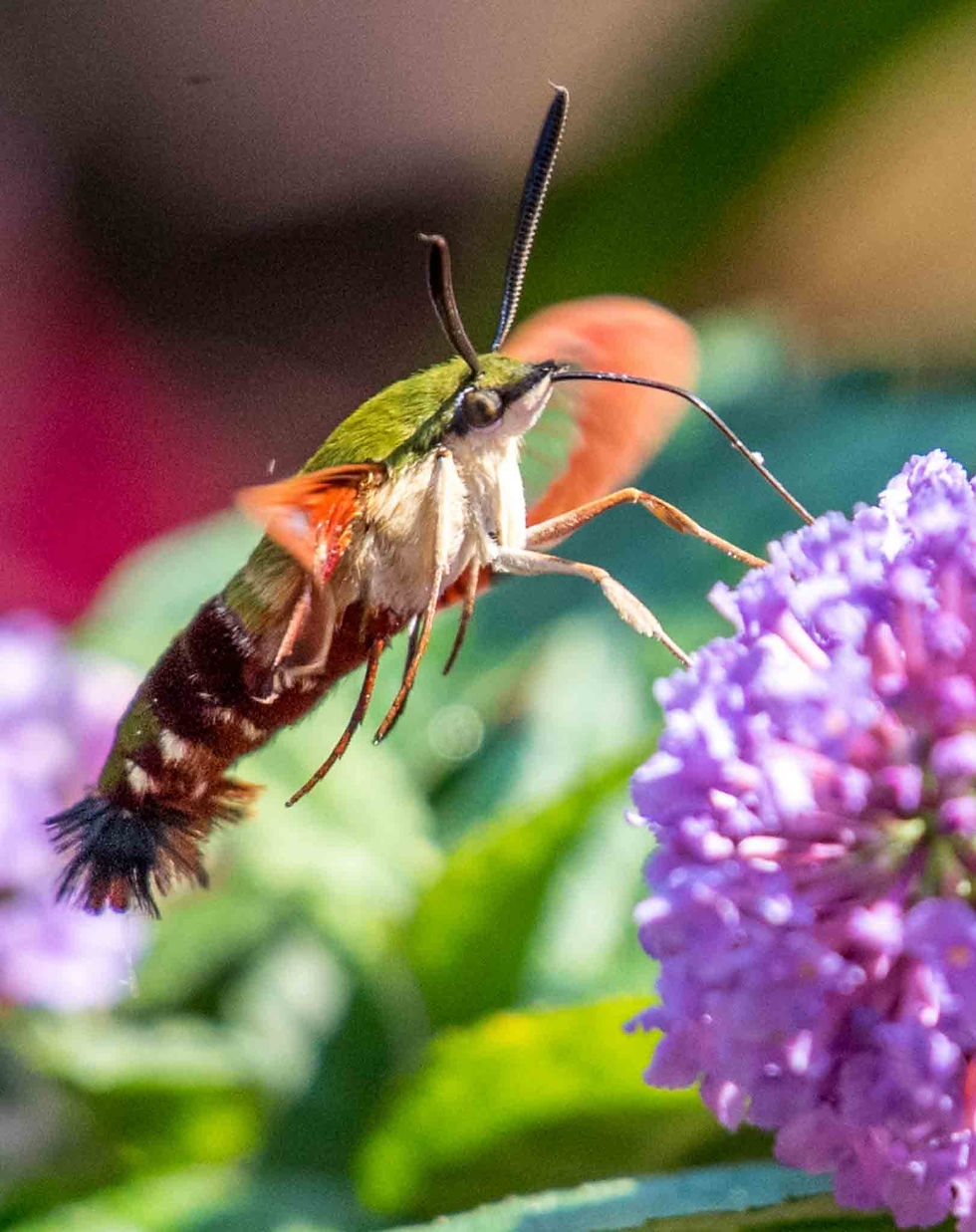
Proboscis
/prōˈbäskəs/
an elongated feeding mouthpart attached to the head of an animal–typically tubular and flexible
the most well known example of a proboscis in insects is the feeding tube used by adult butterflies and moths
W.O.W from 2024.07.18
Inflorescence
/ˌinflōˈresns/
simply, the group or cluster of flowers arranged on a stem
it's the complete flower head of a plant that includes stems, stalks, bracts, and flowers
Inflorescence is categorized by the arrangement of flowers on the main axis and by the timing of its flowering.
W.O.W from 2024.09.05
Self fertile
/ˌselfˈfərd(ə)l/
fertile by means of its own pollen or sperm
For example, a self-fertile fruit tree can pollinate itself and produce fruit without needing pollen from another tree.

W.O.W from 2024.09.17
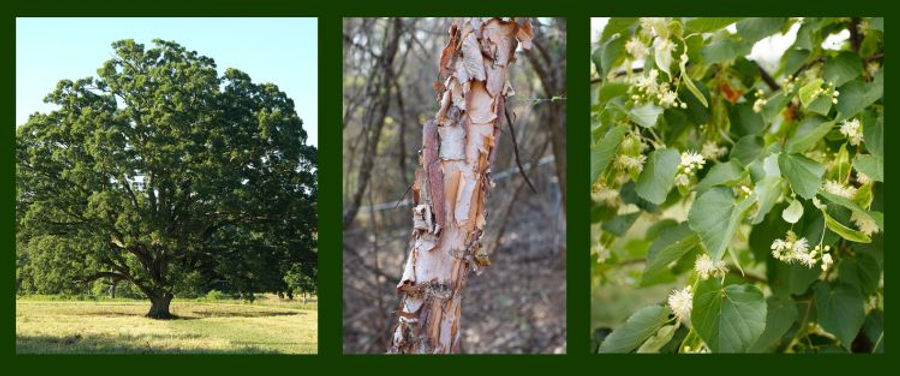
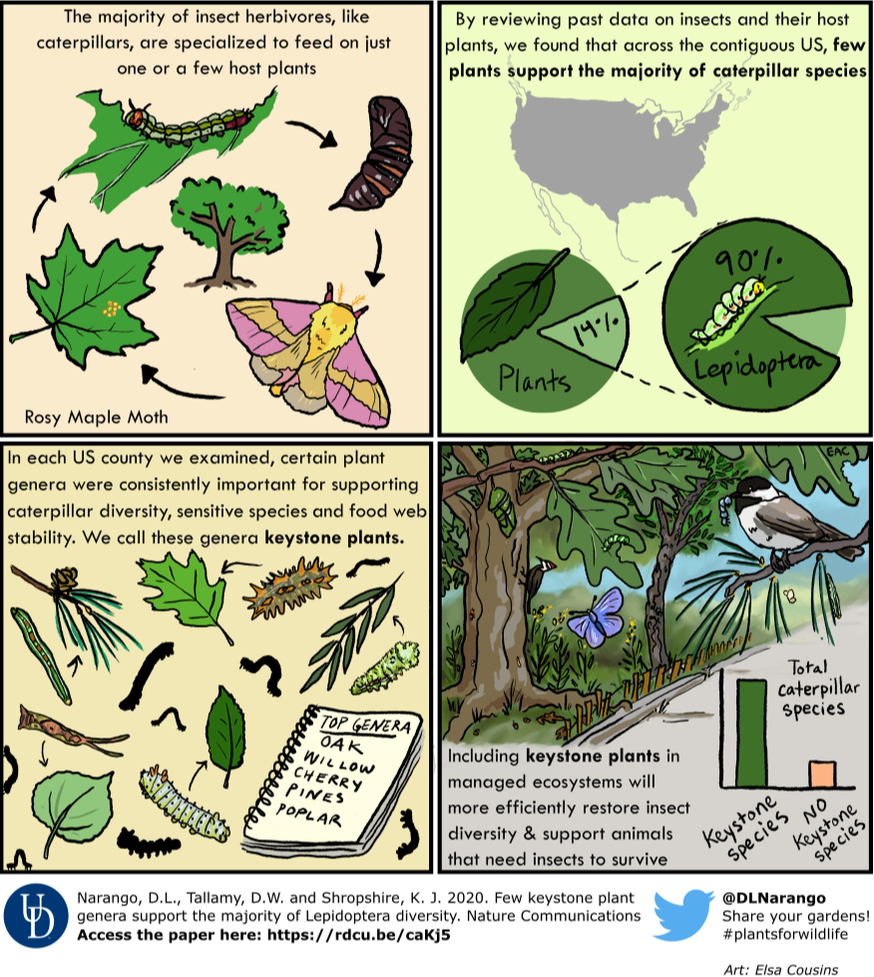
Keystone Plant
Plants that have a very large impact on ecosystem health and vitality.
Generating a network of beneficial relationships and providing critical sources of food and/or shelter for a large number of other species, they are truly native plant superstars!
Read more in Dana's blog:
W.O.W from 2024.09.24
Nativar
/ˈnay·tuh·vär/
a cultivar of a native plant that has been selected for specific traits
Nativars can be natural variants found in the wild or developed by plant breeders.

At Painters, so customers can make the most informed purchases, the dark maroon signage indicates that the plant is a Nativar. Red is for Natives. (Green is Ornamental.) W.O.W from 2025.02.26
Herbaceous
/(h)ərˈbāSHəs/
describes plants with soft rather than woody tissues. They include many perennials, and nearly all annuals and biennials.
Find a wide selection of herbaceous plants at Painters:
Herbaceous houseplants, some select perennials and annuals, and accent plants are in the main greenhouse.
In early spring, the cold hardy herbaceous perennials and annuals are out on our retail floor. And as the weather warms, you'll find more!
Our Cold Frame (the building to the left of the parking lot) is available for shopping, but remember that many of these herbaceous perennials might still be dormant in early spring
W.O.W from 2025.03.04
Rhizome
/ˈrī-ˌzōm/

A modified plant stem which grows horizontally, under the surface of the soil. New growth then emerges from different points of the rhizome.
Bee balm, ostrich ferns, and mint are examples of rhizomatous plants.
(Not to be confused with rhizomic or rhizomatic...)
W.O.W from 2025.03.11
Drupe
/droop/

a simple fleshy fruit consisting of an outer skin, a usually pulpy and succulent middle layer, and a hard and woody inner shell enclosing a single seed
As a simple fruit, a drupe is derived from a single ovary of an individual flower.
Examples are cherries, peaches, and plums.
Check out our current availability:
W.O.W from 2025.03.18
Catkin
/kat-kin/
slender, spikelike, drooping flower clusters, often resembling kitten tails, that are typically found on trees like oaks, willows, and birches, and are known for releasing pollen via wind pollination
Pussy willow catkins are some of our favorites!

W.O.W from 2025.03.25
Raceme
/ray - seem/
A single stemmed inflorescence with flowers on individual short stalks along a stem. The bottom flowers open first as the raceme continues to elongate.
Snapdragon and Delphinium flowers grow on racemes
W.O.W from 2025.04.01
Trichome
/ˈtri-ˌkōm/
An epidermal hair structure on a plant.
Trichomes, particularly glandular trichomes, are directly related to a plant's aroma because they are the structures that produce and store the volatile compounds that give plants their characteristic scents.
In addition to aroma, trichomes also serve as a defense mechanism for plants, deterring pests and herbivores with their sticky resin and strong scents.
Some of our favorite herbs (with vigorous trichomes!) are Mandarin Lemon Balm, Honey Melon Pineapple Sage, and Cinnamon Basil! Plus all the mints! Mmmmmmmmm!

W.O.W from 2025.04.09
Mutualism
/myoo-choo-uh-liz-uhm/

a symbiotic relationship where two species benefit from each other in a close and prolonged association
it can occur between species of the same or different species
For example, pollinators and flowers engage in mutualism where bees obtain nectar for food and flowers benefit from pollination.
Mutualism is a common and important phenomenon in ecosystems, playing a significant role in shaping biodiversity and the evolution of species. Mutualism is thought to have played a major role in the diversification of life on Earth. It's vital to life itself.
Read our blog about Figs and Wasps:

W.O.W from 2025.04.15
Bract
/brakt/
A specialized leaf or leaflike part that protects a flower or other reproductive structure on a plant.
Usually growing just below a flower or flower cluster, it is often confused with petals or sometimes the flower itself, as in the case of dogwoods or bougainvilleas.

W.O.W from 2025.04.23
Emergent Plant
/ih-mur-juhnt/
Emergent plants grow in shallow water areas like marshes, along lake shores, and in wetlands, where they form a transitional zone between wet and dry environments.
These plants are rooted in the substrate (like the bottom of a pond or lake) but their stems, leaves, and flowers grow above the water surface. They provide habitat for fish and wildlife, provide food for waterfowl, and they can help reduce shoreline erosion.
Sometimes called Marginal plants as well.
Read more about these plants at Painters:

W.O.W from 2025.04.30
Fasciated flowers
/fash-ee-ey-shuhn/
flattened, elongated shoots and flower heads that look like many stems compressed together into a band or bundle
while not common, it is not considered rare across plant species and usually not of concern
This strange-looking development may be ugly or attractive, but is always interesting!
W.O.W from 2025.05.06
Understory
/uhn-der-stohr-ee/
A forest layer between the canopy and the forest floor, typically composed of small trees, shrubs, vines and other lower-lying vegetation. It receives less sunlight than the canopy and is often characterized by a humid and sheltered environment.
It plays a crucial role in ecosystem functioning by influencing stand development, fire behavior, and providing habitats for various wildlife species.
In a garden, the understory refers to the layer of plants that grow beneath the taller canopy of trees or other large plants. These plants are shade-tolerant and can contribute to the overall beauty and complexity of a garden.
W.O.W from 2025.05.13
Anemochory
/uh-nem-uh-kohr-ee/
the dispersal of plant seeds or spores by wind
A common method of seed dispersal, anemochory relies on the wind to carry seeds and fruits away from the parent plant.
Plants that rely on anemochory often have adaptations like wings, hairs, or plumes on their seeds or fruits to facilitate their transport by wind.
Examples include dandelion seeds with pappi, milkweed seeds with fluffy hairs, and maples with winged fruits.
W.O.W from 2025.05.20
Samara
/sə-ˈma-rə/
a type of winged, dry fruit that helps disperse seeds through wind, as of the elm or maple
Popularly referred to as helicopters!
The shape of a samara with its thin, dry, wing-like projection at one end and an enclosed seed at the other enables the wind to carry the seed further away from the tree than regular seeds would go, and is thus a form of anemochory (see above).

W.O.W from 2025.05.27
Monoecious plant
/muh-nee-shuhs/
Plants bearing separate male and female flowers on the same plant potentially leading to self-pollination and fertilization.
i.e. Tuberous begonias are monoecious. Tuberous begonias bear male and female flowers on the same plant. Produced in clusters of three, with two smaller female flowers next to the larger, usually double, male flower.

W.O.W from 2025.06.03
Soft Landings
Soft landings are diverse native plantings under keystone trees (or any other regionally appropriate native tree).
These plantings provide critical shelter and habitat for one or more life cycle stages of moths, butterflies, and beneficial insects such as bumble bees, fireflies, lacewings, and beetles.
In addition to plants, soft landings also include leaf litter, duff, and plant debris. Read more here:
W.O.W from 2025.06.17
Phalaenophily
/fuh-lay-NAH-fuh-lee/
pollination by moths, specifically when moths act as the primary pollinators of a plant
It's a type of pollination syndrome where plants and their pollinators have co-evolved traits that attract and facilitate moth pollination.
Some examples are nocturnal blooms, pale or white colors, strong sweet scents, or large, funnel-shaped structures.
W.O.W from 2025.07.21
Vernalization
/vərnəˌlīˈzāSHən/
The induction of a plant's flowering process by exposure to prolonged cold—either from winter or artificially.
After vernalization, plants have acquired the ability to flower but may require additional seasonal cues or weeks of growth before they will actually do so.
Critical for the bulbs we love to sell in the fall!

W.O.W from 2025.09.16
Cold Stratification
/strat-uh-fi-key-shuhn/
The process of subjecting certain seeds to a period of cold, moist conditions to break their dormancy and prepare them for germination. This mimics the natural overwintering process seeds undergo in the wild, where cold temperatures soften the hard seed coat and trigger the embryo.
Find native plant seeds and seed mixes in stock from Sow True Seed. Or maybe scoop up any of the many plants that reseed readily for natural cold stratification: northern sea oats, hardy ageratum, rudbeckia, frost aster, coneflower, and more!
Read more in our seed-sowing blog:

W.O.W from 2025.09.23
Cauliflory
/kaw-li-flawr-ee/
from the Latin caulis = stem and flory = flower
a botanical term for when flowers grow on mature trunks and branches rather than at stem tips and new shoots
It is an adaptation that allows for pollination and seed dispersal by animals climbing on the limbs and trunks to feed on nectar and fruits–an important support for pollination in a forest understory specifically.
Redbuds are trees that do this, although they also bloom on stems.
Check out the availability of redbuds at Painters:

W.O.W from 2025.09.30
Aggregate fruit
/ˈaɡrəɡət ˌfro͞ot/
a single fruit formed from a single flower that has numerous separate ovaries, each developing into a small fruitlet
These individual fruitlets, such as the drupelets in a blackberry or raspberry, merge or appear clustered together into a single, larger fruit structure.
find (potential) aggregate fruits in the fruit trees and shrubs at Painters
One of our new favorites: the ‘Glencoe’ raspberry–a cross between black and red raspberry strains. Its sweet purple berries are delicious fresh or cooked!
W.O.W from 2025.10.07
Marcescence
/mar-CESS-enss/
when deciduous trees hold on to much of their dead leaves until spring
Done mainly by oaks and beeches, but also witch hazels and hornbeams and occasionally Japanese maples.
The leaves often change color in the fall but won’t fall off the branch. They stay, wrinkled and brown, until new growth pushes them off the branch.

As we celebrate the season of dormancy and quiet, the marcescent leaves are the backdrop to the soundtrack of winter. The cold, quiet rustling of held leaves. See you soon in the spring! When the oak leaves fall…
W.O.W from 2025.10.14


